Back to Music Theory Fundamentals

Suspended Chord

Suspended chords, often abbreviated as sus chords, are a type of chord alteration where one of the standard scale degrees above the root of the chord is replaced by a note one higher in the scale. For example, a I chord contains scale degrees 1, 3, and 5 (C, E, and G in the key of C), and a Isus4 chord would replace the 3 with a 4, using scale degrees 1, 4, and 5.

A Vsus4 chord would use scale degrees 5, 1, and 2 rather than the usual 5, 7, and 2:
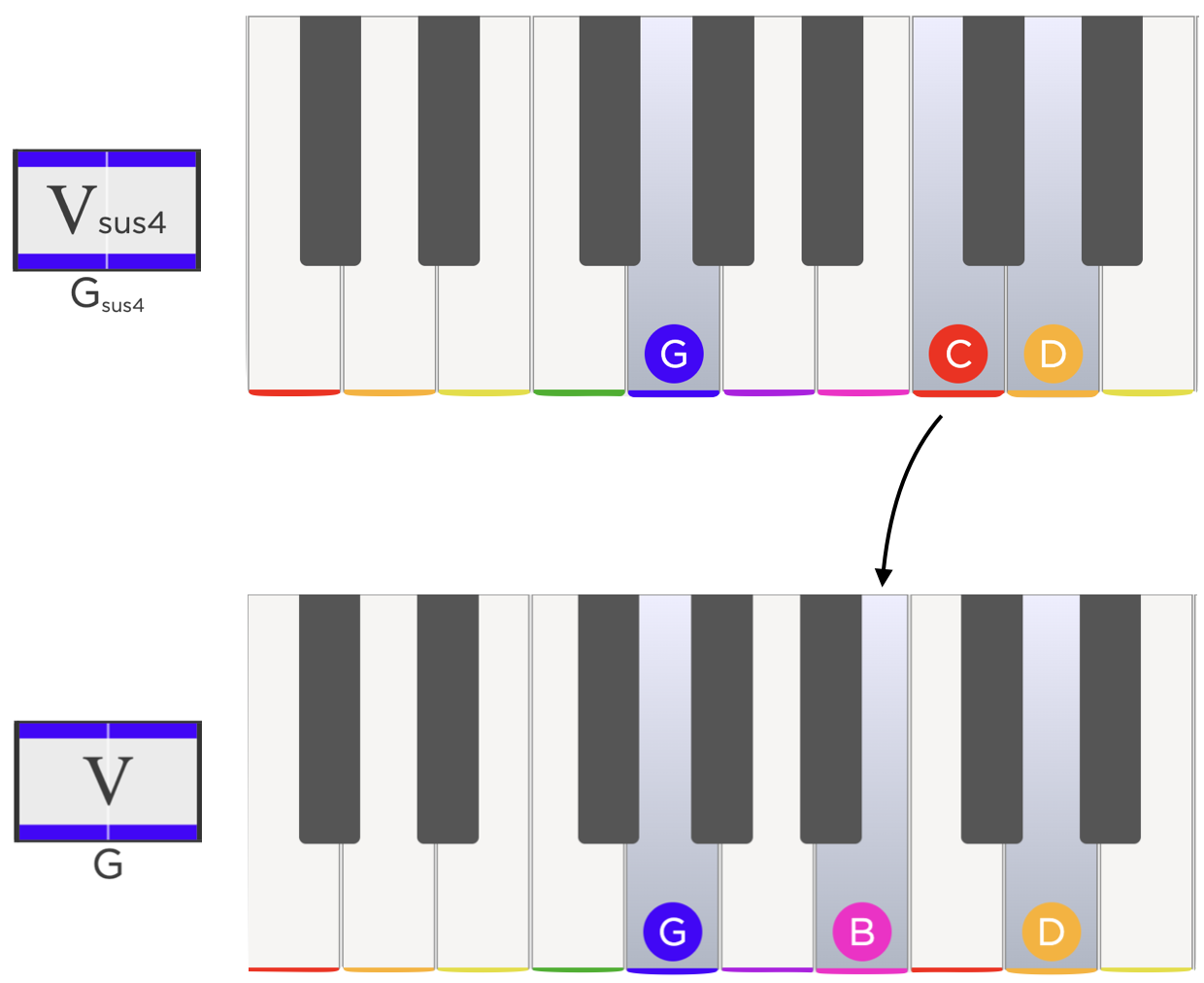
Suspension resolution example for V chord

This adjustment introduces a distinctive tension, as the “suspended” note—positioned a scale degree above the typical third—creates an expectation for resolution. Suspended chords are generally resolved to their basic chord counterparts, offering a satisfying release as the fourth resolves down to the third.

Commonly used sus4 chords include Vsus4 and Isus4, where the added tension can embellish harmonic progressions, particularly at cadences, by temporarily delaying resolution to a pure home base sound. Their balance of tension and eventual stability adds depth and nuance to chord progressions.

The song “Ka Nohona Pili Kai” by Keali’i Reichel is an example of a song that uses both Isus4 and Vsus4 chords at the end of each four-bar phrase.

placeholder box

Other songs that use suspended chords

Click on the following songs to see their chords and melody in the TheoryTab database.

Baby One More Time
by Britney Spears
Viva La Vida
by Coldplay
ET
by Katy Perry
My Way
by Frank Sinatra
It's My Life
by No Doubt
Smile Smile Smile
by My Little Pony
Levon
by Elton John
Ziggy Stardust
by David Bowie
Brokenhearted
by Karmin
Desperado
by Eagles
Super Hexagon Theme 1
by Chipzel
Hard To Say I'm Sorry
by Chicago
Easy
by Commodores
Your Song
by Elton John
Teenage Mutant Ninja Turtles Theme
by Chuck Lorre
Sweet Dreams
by Beyonce
All The Small Things
by Blink 182
You Are Not Alone
by Michael Jackson
Tangerine
by Led Zeppelin
Crazy
by Gnarls Barkley
Morning Music
by Konami
Seven Days in Sunny June
by Jamiroquai
Wide Awake
by Katy Perry
Best Of You
by Foo Fighters
Final Fantasy IV World Theme
by Nobuo Uematsu
My Grown Up Christmas Wish
by Kelly Clarkson
Boston
by Augustana
Defying Gravity
by Lea Michele from Glee
Iris
by Goo Goo Dolls
Winter Wrap Up
by My Little Pony
Skyfall
by Adele
When You're Gone
by Avril Lavigne
Atma Weapon Theme
by Nobuo Uematsu
November Rain
by Guns N' Roses
Soviet National Anthem
by Alexander Alexandrov
Teenage Dream
by Katy Perry
Genie
by Girls' Generation
The Legend Of Zelda Fairy Theme
by Nintendo
The Scientist
by Coldplay
The Rock Theme
by Hans Zimmer
The Show Goes On
by Lupe Fiasco
The Veldt
by deadmau5
She's Always a Woman
by Billy Joel
My Heart Will Go On
by Celine Dion
Take A Bow
by Madonna
Starlight
by Muse
Because Of You
by Kelly Clarkson
Stairway to Heaven
by Led Zeppelin
I Don't Want To Miss A Thing
by Aerosmith
100 Years
by Five For Fighting
Smells Like Teen Spirit
by Nirvana
Have You Ever Seen the Rain
by Creedence Clearwater Revival
Walt Graces Submarine Test January 1967
by John Mayer
Be Like That
by 3 Doors Down
Ken's Theme
by Capcom
I'm Not a Girl Not Yet a Woman
by Britney Spears
Good-bye Baby
by Miss A
Say My Name
by Destiny's Child
Beautiful Stranger
by Madonna
Domino
by Jessie J
Bring Me To Life
by Evanescence
Titanium feat Sia
by David Guetta
Can You Feel the Love Tonight
by Elton John
Breathe
by Faith Hill
I Gotta Feeling
by Black Eyed Peas
Walkaways
by Counting Crows
Already Gone
by Kelly Clarkson
Skyscraper
by Demi Lovato
Set Fire to the Rain
by Adele
Black or White
by Michael Jackson
Every Time We Touch
by Cascada
Sweet Victory
by David Glen Eisley
Strobe
by deadmau5
Give Your Heart A Break
by Demi Lovato
Final Fantasy Prologue
by Nobuo Uematsu
Love The Way You Lie ft Rihanna
by Eminem
Mardy Bum
by Arctic Monkeys
Living On A Prayer
by Bon Jovi
I Get Around
by Beach Boys

Contents

Music Fundamentals

The 7 notes that are the building blocks of a song
The spacing between notes

Functional Harmony

The study of how chords work
Establishing the set of notes and chords used in a song
A powerful framework for understanding how songs work
Numbering notes within a key
Numbering chords within a key

Basic Chord Concepts

Chords naturally found in the key
Different chord sounds and their function
Different ways of playing or arranging the same chord
Ending a musical idea

Melody

A song's rhythmic framework
Understanding melody tension over chords

Advanced Chords

Using a different bass note to change a chord's sound
Adding one more note to the basic chords
Chords that temporarily shift the harmonic center
A chord with built in tension and release
A chord with an added tone that enriches its sound
Using chords from parallel modes for contrast and emotion
Jazz harmonic technique replacing dominant chords with chords a tritone away
Altered (raised or lowered) notes create tension and complexity in chords

Advanced Concepts in Harmony

Two ways to change a song's key
Borrowing chords from another key
New scales and home base chords for a different mood
Using notes within and outside a song's key
Progressions that connect the bass