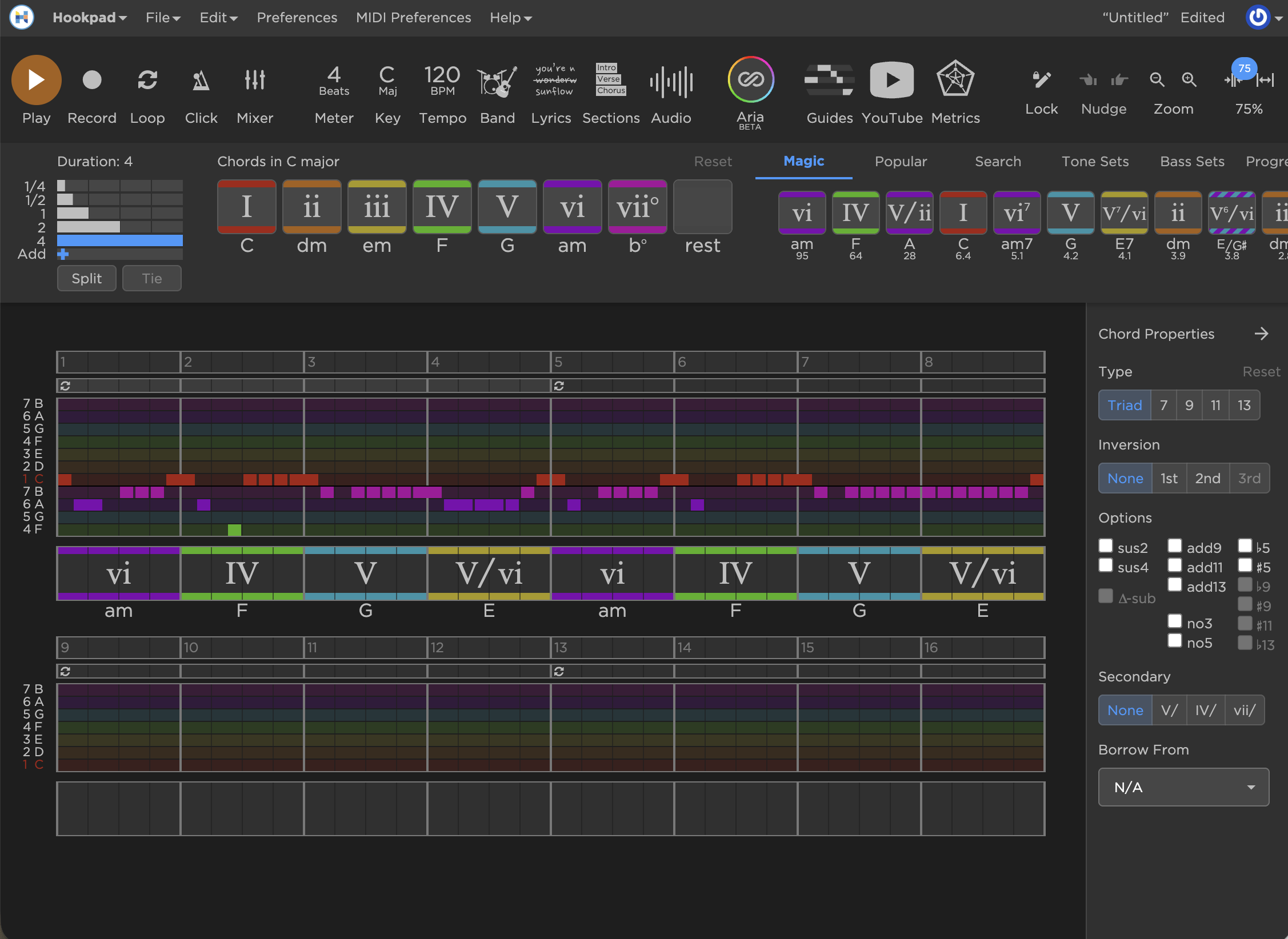

Greener – Verse

Greener – Verse and Pre-Chorus
Greener – Chorus
Greener – Solo
Related Music Concepts
Inverted Chords
Using a different bass note to change a chord's sound
Seventh Chords
Adding one more note to the basic chords
Borrowed Chords
Using chords from parallel modes for contrast and emotion
Bassline Motion
How much the bass moves stepwise between chord roots
Diminished Chords
A chord built from stacked minor thirds — dark and unstable
Secondary Chords
Chords that temporarily shift the harmonic center
Chord-Melody Tension
How much the melody clashes with the underlying chords
Song Stats
●
Key
E Major
Tempo
162 BPM
Meter
4/4
Genre
Pop, Rock, Experimental/Avant-Garde
Melody Range
B2 – E4
Mood
Tense, Upbeat, Bright
Most Used Chord
I
Chord Complexity
58
Chord Complexity: Tracks when a song goes beyond simple three-note chords—either by adding extra tones (like 7ths or add9s) or by borrowing notes from outside the key—creating richer, more sophisticated harmonies.
Melodic Complexity
90
Melodic Complexity: Reflects two factors: the use of notes outside the key and rhythmic syncopation, together capturing how intricate or surprising a melody feels.
Chord-Melody Tension
64
Chord-Melody Tension: Quantifies how often melody notes fall outside the current chord, producing dissonance that creates a sense of instability.
Chord Prog. Novelty
58
Chord Prog. Novelty: Measures how uncommon a song's chord changes are compared to others in the Hooktheory database, highlighting progressions that deviate from typical patterns.
Song Stats
●
Key
E Major
Tempo
162 BPM
Meter
4/4
Genre
Pop, Rock, Experimental/Avant-Garde
Melody Range
B2 – E4
Mood
Tense, Complex, Unexpected, Upbeat, Bright
Most Used Chord
I(no3)
Chord Complexity
72
Chord Complexity: Tracks when a song goes beyond simple three-note chords—either by adding extra tones (like 7ths or add9s) or by borrowing notes from outside the key—creating richer, more sophisticated harmonies.
Melodic Complexity
88
Melodic Complexity: Reflects two factors: the use of notes outside the key and rhythmic syncopation, together capturing how intricate or surprising a melody feels.
Chord-Melody Tension
76
Chord-Melody Tension: Quantifies how often melody notes fall outside the current chord, producing dissonance that creates a sense of instability.
Chord Prog. Novelty
69
Chord Prog. Novelty: Measures how uncommon a song's chord changes are compared to others in the Hooktheory database, highlighting progressions that deviate from typical patterns.
Concepts
Song Stats
●
Key
E Major
Tempo
163 BPM
Meter
4/4
Genre
Pop, Rock, Experimental/Avant-Garde
Melody Range
E3 – F#4
Mood
Tense, Upbeat, Bright
Most Used Chord
IV
Chord Complexity
25
Chord Complexity: Tracks when a song goes beyond simple three-note chords—either by adding extra tones (like 7ths or add9s) or by borrowing notes from outside the key—creating richer, more sophisticated harmonies.
Melodic Complexity
69
Melodic Complexity: Reflects two factors: the use of notes outside the key and rhythmic syncopation, together capturing how intricate or surprising a melody feels.
Chord-Melody Tension
82
Chord-Melody Tension: Quantifies how often melody notes fall outside the current chord, producing dissonance that creates a sense of instability.
Chord Prog. Novelty
37
Chord Prog. Novelty: Measures how uncommon a song's chord changes are compared to others in the Hooktheory database, highlighting progressions that deviate from typical patterns.
Song Stats
●
Key
E Major
Tempo
162 BPM
Meter
4/4
Genre
Pop, Rock, Experimental/Avant-Garde
Melody Range
E2 – A5
Mood
Tense, Complex, Unexpected, Upbeat, Bright
Most Used Chord
I
Chord Complexity
77
Chord Complexity: Tracks when a song goes beyond simple three-note chords—either by adding extra tones (like 7ths or add9s) or by borrowing notes from outside the key—creating richer, more sophisticated harmonies.
Melodic Complexity
97
Melodic Complexity: Reflects two factors: the use of notes outside the key and rhythmic syncopation, together capturing how intricate or surprising a melody feels.
Chord-Melody Tension
98
Chord-Melody Tension: Quantifies how often melody notes fall outside the current chord, producing dissonance that creates a sense of instability.
Chord Prog. Novelty
72
Chord Prog. Novelty: Measures how uncommon a song's chord changes are compared to others in the Hooktheory database, highlighting progressions that deviate from typical patterns.
Concepts
Song Stats
●
Key
E Major
Tempo
162 BPM
Meter
4/4
Genre
Pop, Rock, Experimental/Avant-Garde
Melody Range
E2 – A5
Mood
Tense, Upbeat, Bright
Most Used Chord
I
Chord Complexity
61
Chord Complexity: Tracks when a song goes beyond simple three-note chords—either by adding extra tones (like 7ths or add9s) or by borrowing notes from outside the key—creating richer, more sophisticated harmonies.
Melodic Complexity
92
Melodic Complexity: Reflects two factors: the use of notes outside the key and rhythmic syncopation, together capturing how intricate or surprising a melody feels.
Chord-Melody Tension
91
Chord-Melody Tension: Quantifies how often melody notes fall outside the current chord, producing dissonance that creates a sense of instability.
Chord Prog. Novelty
60
Chord Prog. Novelty: Measures how uncommon a song's chord changes are compared to others in the Hooktheory database, highlighting progressions that deviate from typical patterns.
About Greener
About the Key
E Major
It is the 5th most popular key among Major keys and the 5th most popular among all keys. Major keys, along with minor keys, are a common choice for popular songs.
I IV V
Most Important Chords
The three most important chords, built off the 1st, 4th and 5th scale degrees are all major chords (E Major, A Major, and B Major).
E Major Cheat Sheet
Popular chords, progressions, downloadable MIDI files and more
About the Chord Progressions
About the Melody
Melody data is compiled from all analyzed melody sections, so depending on how a user analyzed a song, "melody" might include instrumental notes.
E2 – A5
Melody range across 41 semitones
1.10 beats/note
Across 277.5 beats of melody
Stepwise Motion
Jumpiness
Repeaty
90%
Diatonic
Percentage of notes within the song's key.
59%
Chord Tones
Percentage of notes that fall on a chord tone of the underlying harmony.
Mixed
Consonance
How smoothly the melody blends with the harmony (0 = dissonant, 1 = consonant).
Loose
Syncopation
How often the melody emphasizes off-beats. Higher = more syncopated.
About the Metrics
Chord Complexity
Chord Complexity tracks when a song goes beyond simple three-note chords—either by adding extra tones (like 7ths or add9s) or by borrowing notes from outside the key—creating richer, more sophisticated harmonies.
Melodic Complexity
Melodic Complexity reflects two factors: the use of notes outside the key and rhythmic syncopation, together capturing how intricate or surprising a melody feels.
Chord-Melody Tension
Chord-Melody Tension quantifies how often melody notes fall outside the current chord, producing dissonance that creates a sense of instability.
Chord Progression Novelty
Chord Progression Novelty measures how uncommon a song's chord changes are compared to others in the Hooktheory database, highlighting progressions that deviate from typical patterns.
Chord-Bass Melody
Chord–Bass Melody evaluates how smoothly the bass moves between chords, scoring higher when it travels step-wise, ascending or descending, instead of jumping directly between root position chords.
Hooktheory's metrics are calculated against the entire database of analyzed songs, where 50 is the "average song." Learn more about each of these metrics here.
Chord Complexity
61
Measures how diverse and sophisticated the chord vocabulary is in this song.
Percentile: 61/100 — above average
Melodic Complexity
92
Measures the range, intervallic variety, and rhythmic complexity of the melody.
Percentile: 92/100 — above average
Chord-Melody Tension
91
Measures how much the melody notes clash or harmonize with the underlying chords.
Percentile: 91/100 — above average
Chord Prog. Novelty
60
Measures how unusual or unexpected the chord progressions are compared to common patterns.
Percentile: 60/100 — above average
Chord-Bass Melody
84
Measures the melodic movement of the bass notes across chord changes.
Percentile: 84/100 — above average
Song Data
Metrics Radar Chart
GreenerAverage Song
BPM Comparison
Melody Distribution
1
2
3
4
5
6
7
Melodic Intervals
Distribution of note-to-note jumps in semitones (negative = downward, positive = upward)
Note Durations
How long each note is held (in beats)
Syncopation
How many notes fall on each level of metric strength (0 = on-beat, higher = increasingly off-beat)
Level 0
Notes that fall on the downbeat — the strongest metric position in the measure.
Level 1
Notes on a secondary strong beat (e.g. beat 3 in 4/4) — still firmly on the grid.
Level 2
Notes on the remaining primary beats (2 and 4 in 4/4) — moderate metric weight.
Level 3
Notes on eighth-note offbeats — between the primary beats. Audibly syncopated.