Back to Music Theory Fundamentals

Inverted Chord / Inversion

An inversion is a type of chord voicing where the lowest note (bass note) is not the root of the chord. In a standard basic chord, the root is the lowest note — this is called root position. For example, a C major chord in root position has C in the bass.

Inversions use one of the other notes from the chord (like the third or fifth) as the bass note instead. For example:

  • First inversion: E is the bass (the third of the chord)
  • Second inversion: G is the bass (the fifth of the chord)

Inverted chords sound slightly different from root-position chords, and they often serve different musical functions. While they don’t change the chord’s harmonic identity, they can create smoother bass motion and more varied voice leading within a chord progression.

Roman numeral notation uses small numbers to the right of the chord numeral to indicate inversions: 6 for first inversion and 64 for second inversion. These numbers reflect the intervals above the bass when the chord is in closed position (the most compact voicing).
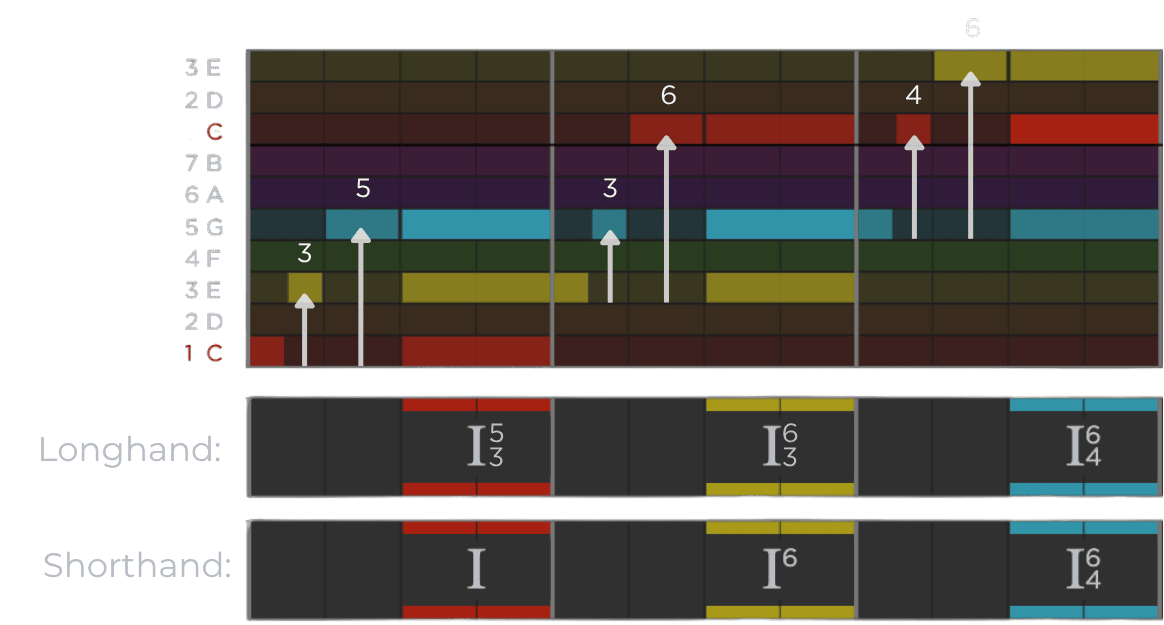
Below is a demonstration of a I chord in all its inversions, written as individual notes in the melody staff so you can hear how each one sounds:

placeholder box

The example below features a mix of root-position I chords and a I chord in first inversion. You’ll hear how the inversion gives the progression a subtle change in feel and flow, especially in the bass line.

placeholder box

Unlike voicing changes that simply rearrange a chord’s notes above the bass, inversions are considered musically distinct because they affect the chord’s function — especially how it connects to the chords around it.

Inversions of seventh chords

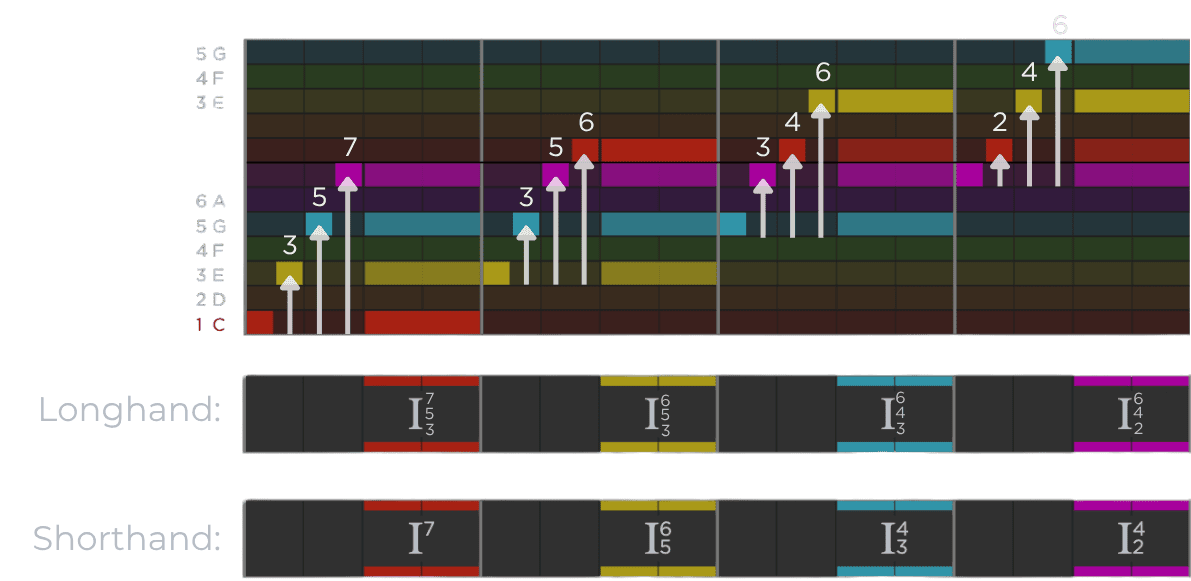
Since Seventh chords have four chord tones instead of three, there are three possible inversions apart from root position, and the intervals made to the bass note are different than for normal triads. The three inversions are as follows: first inversion 65, second inversion 43, and third inversion 42.

Other songs that use chord inversions

Click on the following songs to see their chords and melody in the TheoryTab database.

Love The Way You Lie ft Rihanna
by Eminem
Your Song
by Elton John
Levon
by Elton John
All American Girl
by Carrie Underwood
Tiny Dancer
by Elton John
White Christmas
by Bing Crosby
Set Fire to the Rain
by Adele
Breathe
by Faith Hill
My Heart Will Go On
by Celine Dion
I Will Follow You Into the Dark
by Death Cab for Cutie
When I Was Your Man
by Bruno Mars
Realize
by Colbie Caillat
Where Are We Now
by David Bowie
We Are Young
by Fun
Forget You
by Cee Lo Green
Can You Feel The Love Tonight
by Disney
Uninvited
by Alanis Morissette
Say Yes
by Elliott Smith
Let's Go
by Calvin Harris
Titanium feat Sia
by David Guetta
I Don't Want To Miss A Thing
by Aerosmith
Be Like That
by 3 Doors Down
Can't Help Falling In Love
by Elvis Presley
Strobe
by deadmau5
Baby One More Time
by Britney Spears
Wild Ones
by Flo Rida
Out From Under
by Britney Spears
Downstream
by Braid Soundtrack
A Team
by Ed Sheeran
Ever Ever After
by Carrie Underwood
Big Bang Theory Theme Song
by Bare Naked Ladies
I'll Make Love To You
by Boyz II Men
You Shook Me All Night Long
by ACDC
Bring Me To Life
by Evanescence
Give Your Heart A Break
by Demi Lovato
Boston
by Augustana
Rolling In The Deep
by Adele
Piano Man
by Billy Joel
Desperado
by Eagles
Easy
by Commodores
When You're Gone
by Avril Lavigne
Breezeblocks
by Alt-J
Jupiter
by Ayaka Hirahara
So Small
by Carrie Underwood
Take Care
by Drake
Hard To Say I'm Sorry
by Chicago
Someone Like You
by Adele
Have You Ever Seen the Rain
by Creedence Clearwater Revival
Jar Of Hearts
by Christina Perri
Ziggy Stardust
by David Bowie
Come On Over
by Christina Aguilera
Super Hexagon Theme 1
by Chipzel
Mardy Bum
by Arctic Monkeys
Rimushotto Bungie Jump
by Frog Fractions Soundtrack
Genie
by Girls' Generation
So In Love
by Cole Porter - Ella Fitzgerald
She's Always a Woman
by Billy Joel
Every Time We Touch
by Cascada
If We Hold On Together
by Diana Ross
My Way
by Frank Sinatra
You Look Wonderful Tonight
by Eric Clapton
Up Around the Bend
by Creedence Clearwater Revival
Hurts Like Heaven
by Coldplay
I Get Around
by Beach Boys
100 Years
by Five For Fighting
Parachute
by Cheryl Cole
I Gotta Feeling
by Black Eyed Peas
Skyscraper
by Demi Lovato
Soviet National Anthem
by Alexander Alexandrov
I'm Not a Girl Not Yet a Woman
by Britney Spears
Enjoy the Silence
by Depeche Mode
Sweet Dreams
by Beyonce
Memories
by David Guetta
I Can't Help Falling In Love
by Elvis Presley

Contents

Music Fundamentals

The 7 notes that are the building blocks of a song
The spacing between notes

Functional Harmony

The study of how chords work
Establishing the set of notes and chords used in a song
A powerful framework for understanding how songs work
Numbering notes within a key
Numbering chords within a key

Basic Chord Concepts

Chords naturally found in the key
Different chord sounds and their function
Different ways of playing or arranging the same chord
Ending a musical idea

Melody

A song's rhythmic framework
Understanding melody tension over chords

Advanced Chords

Using a different bass note to change a chord's sound
Adding one more note to the basic chords
Chords that temporarily shift the harmonic center
A chord with built in tension and release
A chord with an added tone that enriches its sound
Using chords from parallel modes for contrast and emotion
Jazz harmonic technique replacing dominant chords with chords a tritone away
Altered (raised or lowered) notes create tension and complexity in chords

Advanced Concepts in Harmony

Two ways to change a song's key
Borrowing chords from another key
New scales and home base chords for a different mood
Using notes within and outside a song's key
Progressions that connect the bass