Suspended Chord
Suspended chords, often abbreviated as sus chords, are a type of chord alteration where one of the standard scale degrees above the root of the chord is replaced by a note one higher in the scale. For example, a I chord contains scale degrees 1, 3, and 5 (C, E, and G in the key of C), and a Isus4 chord would replace the 3 with a 4, using scale degrees 1, 4, and 5.
A Vsus4 chord would use scale degrees 5, 1, and 2 rather than the usual 5, 7, and 2:
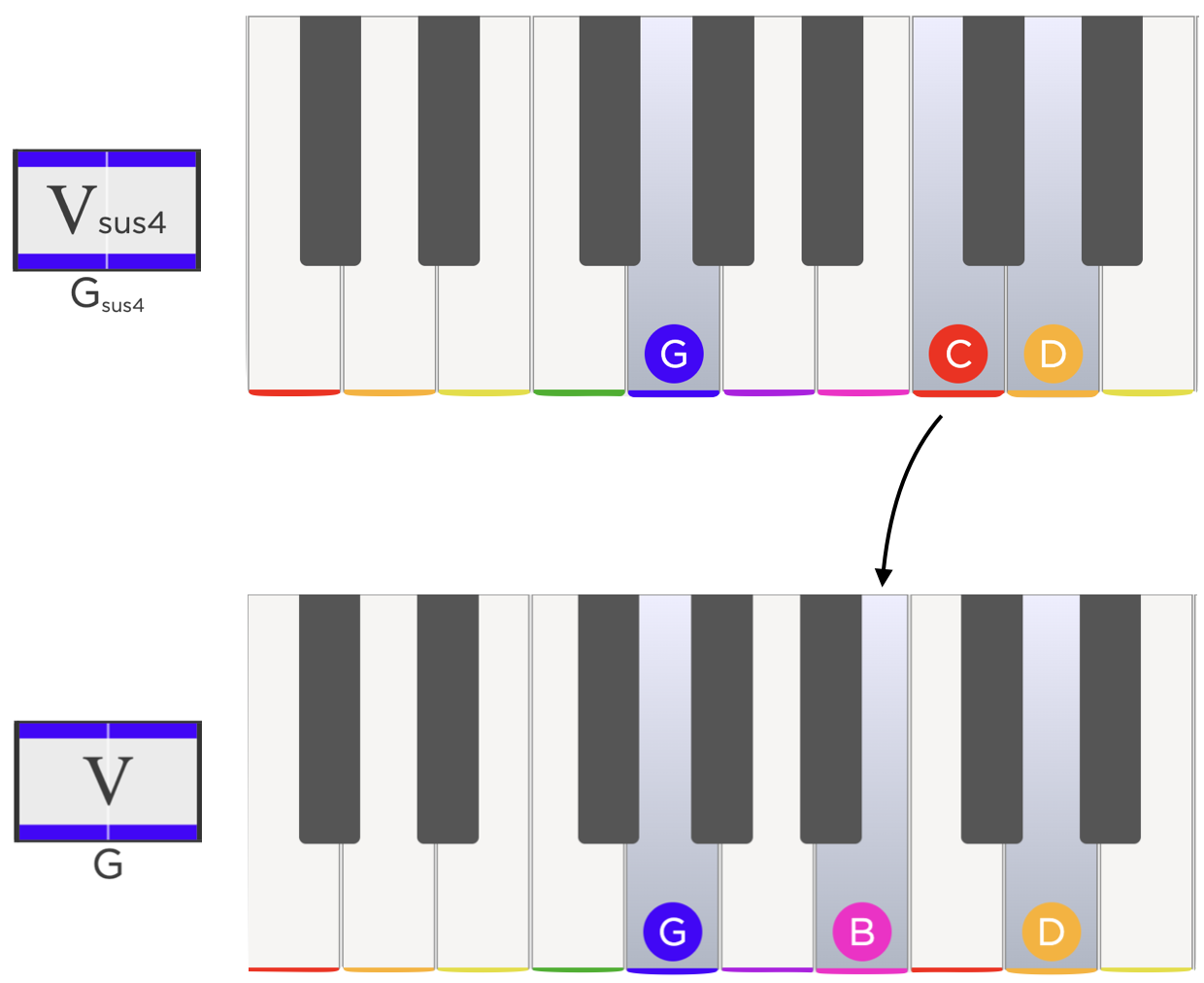
This adjustment introduces a distinctive tension, as the “suspended” note—positioned a scale degree above the typical third—creates an expectation for resolution. Suspended chords are generally resolved to their basic chord counterparts, offering a satisfying release as the fourth resolves down to the third.
Commonly used sus4 chords include Vsus4 and Isus4, where the added tension can embellish harmonic progressions, particularly at cadences, by temporarily delaying resolution to a pure home base sound. Their balance of tension and eventual stability adds depth and nuance to chord progressions.
The song “Ka Nohona Pili Kai” by Keali’i Reichel is an example of a song that uses both Isus4 and Vsus4 chords at the end of each four-bar phrase.