Key
A key in music defines the tonal “home base” for a song. It has two main parts: the tonic and the scale.
For example, in the key of C major, the tonic is C and the scale is major.
The tonic is the central note that the music feels anchored to — it’s the note melodies and harmonies often return to for a sense of resolution. The scale is the set of notes (with specific intervals) built from that tonic. The most common scales used in popular music are major and minor, though other modes are also possible.
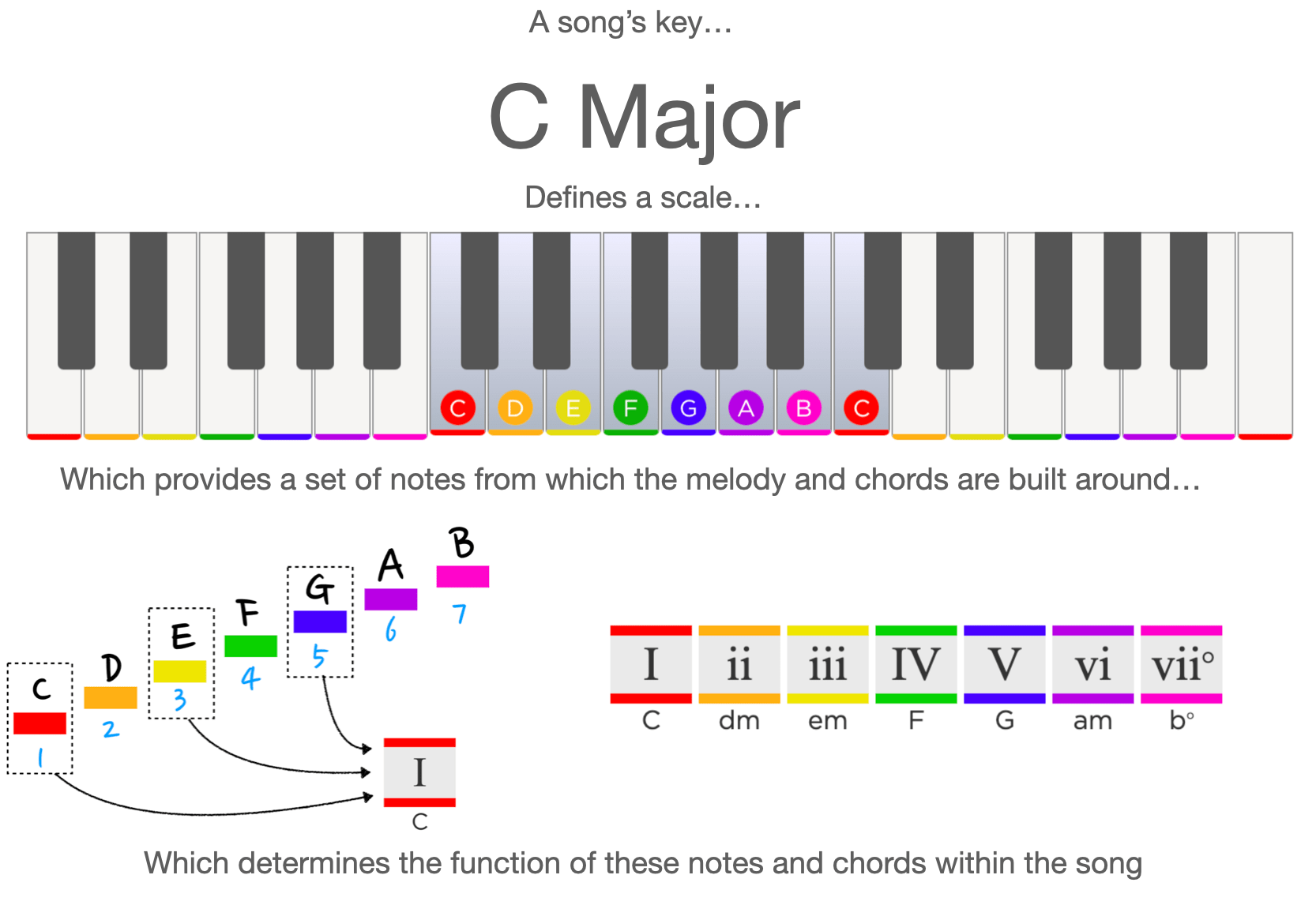
Together, the tonic and scale define the seven notes that form the building blocks for the chords and melodies in a song. For example, a song in the key of C major is based on the notes C, D, E, F, G, A, and B.
From these notes, we get the set of chords commonly used in the key: C major (I), D minor (ii), E minor (iii), F major (IV), G major (V), A minor (vi), and B diminished (vii˚). These Roman numeral names describe each chord’s position and function within the key.
For more information on the most popular keys and their chords, check out the Hooktheory Key Cheat Sheets.